HABITATS FROM SHORE TO DEPTH
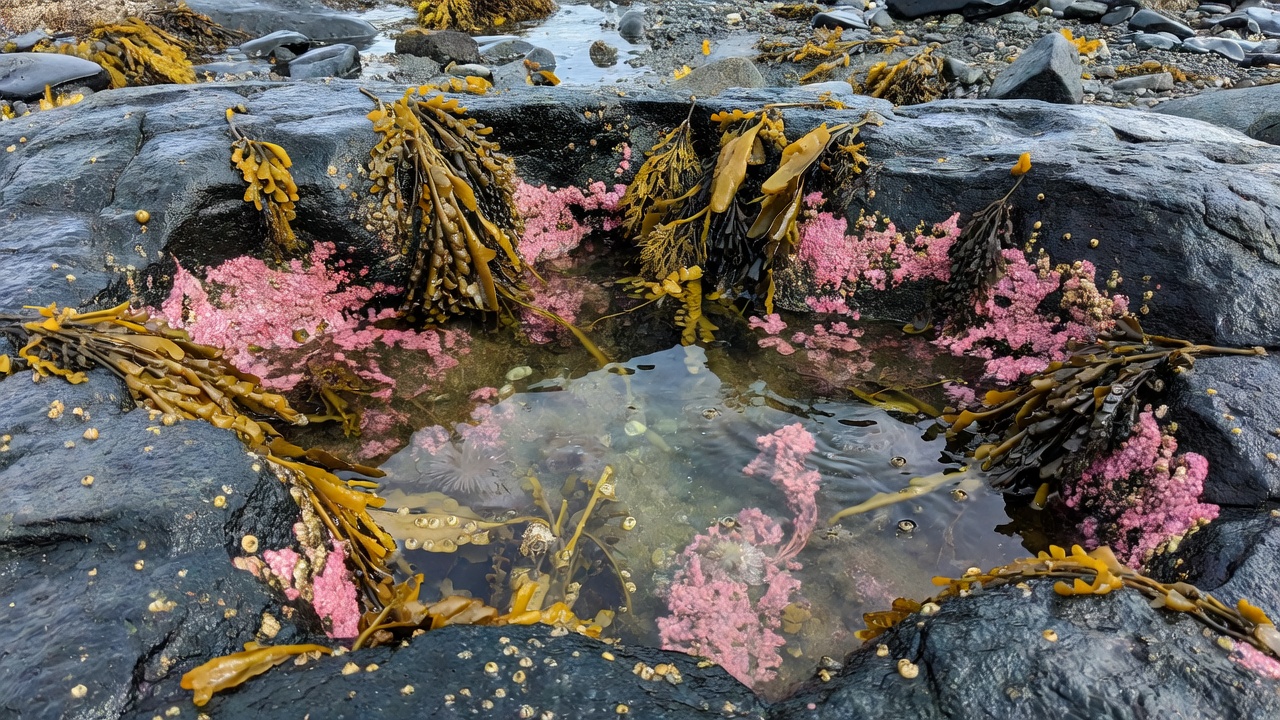
Look closely at a wet granite ledge at low tide and you will see horizontal bands of life: black verrucaria lichen at the splash mark, acorn barnacles (Semibalanus balanoides) below them, and leathery belts of bladderwrack (Fucus vesiculosus) and knotted wrack (Ascophyllum nodosum) draped across the mid-littoral zone. This visible intertidal strip is merely the top rung of a steep vertical ladder that descends more than a kilometer into cold, aphotic water.
1. THE SUBLITTORAL KELP FORESTS (2M TO 30M)
Just below low-water spring tide on wave-exposed outer coasts, tangle kelp (Laminaria hyperborea) and sugar kelp (Saccharina latissima) anchor directly to crystalline bedrock via claw-like holdfasts (haptera). Across the Norwegian strandflat, kelp forests cover thousands of square kilometers, fixing carbon at rates comparable to terrestrial forests.
A single mature Laminaria stipe lives up to 15 years and supports tens of thousands of amphipods, gastropods, brittle stars, and nudibranchs. In Northern Norway, the balance between lush kelp forest and barren rock is regulated by grazing green sea urchins (Strongylocentrotus droebachiensis) and their predators, including edible crabs (Cancer pagurus), wolffish, and coastal cod.
2. SPRING DIATOM BLOOMS AND DEEP FJORD JELLYFISH
In March and April, lengthening daylight and strengthening surface stratification trigger an explosive spring bloom of chain-forming diatoms (Chaetoceros, Thalassiosira, and Skeletonema). Grazing on this bloom is Calanus finmarchicus, a rice-grain-sized copepod that stores over half its dry body weight as high-energy lipid droplets. When autumn darkness returns, Calanus sinks into deep fjord basins (200 to 600 meters) and enters winter diapause, providing a stationary buffet for mesopelagic fish such as pearlside (Maurolicus muelleri) and lanternfish (Benthosema glaciale).
In deep, dark fjords like Lurefjorden north of Bergen, optical conditions and sill isolation sometimes favor tactile predators—specifically the helmet jellyfish (Periphylla periphylla)—over visual fish predators. Because Periphylla produces porphyrin pigments that are toxic when exposed to sunlight, it normally stays below 400 meters in the open ocean; in turbid, steep-walled Norwegian fjords, however, it migrates right up to the surface at night.
3. COLD-WATER CORALS AND SPONGE GARDENS (100M TO 600M)
Norway hosts the largest known concentration of cold-water stony coral reefs (Desmophyllum pertusum) in the world. Unlike tropical corals, Desmophyllum contains no photosynthetic zooxanthellae symbionts. Instead, its polyps extend translucent tentacles into fast bottom currents to capture copepods and marine snow.
Alongside stony corals, gorgonian sea fans—such as the bubblegum coral (Paragorgia arborea), which can reach three meters in height, and Primnoa resedaeformis—colonize vertical fjord overhangs and boulder moraines. On softer gravelly slopes, dense sponge grounds dominated by Geodia barretti filter thousands of liters of water daily, cycling dissolved organic nitrogen and silicon while providing nursery shelter for redfish (Sebastes species) and tusk (Brosme brosme).